Monitoring CORS continuity and data quality together
A healthy reference station needs both reliable data delivery and suitable observations; monitoring should distinguish those dependencies.
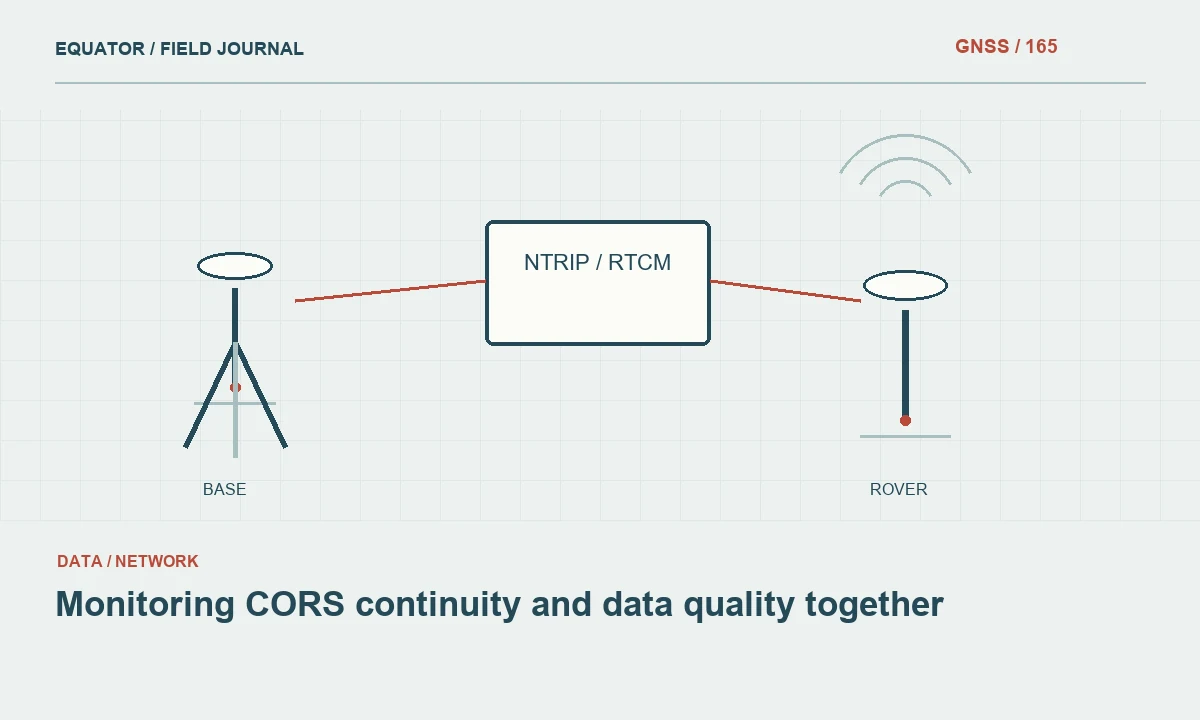
Define what continuous operation means
A continuously operating reference station can fail in several different ways. The receiver may stop recording, the antenna observations may degrade, local storage may fill, real time streaming may stop or archived files may fail to reach users. A single online indicator cannot describe all these conditions. Define the station's service objectives and monitor the measurement, recording and delivery chain as separate but related functions.
Start with the intended users. Real time corrections require timely streams, while postprocessing users may depend on complete observation archives and accurate metadata. A short communications interruption can affect these users differently if local recording continues and missing files are later recovered. The monitoring design should reflect those distinctions rather than classify every incident simply as station down or station up.
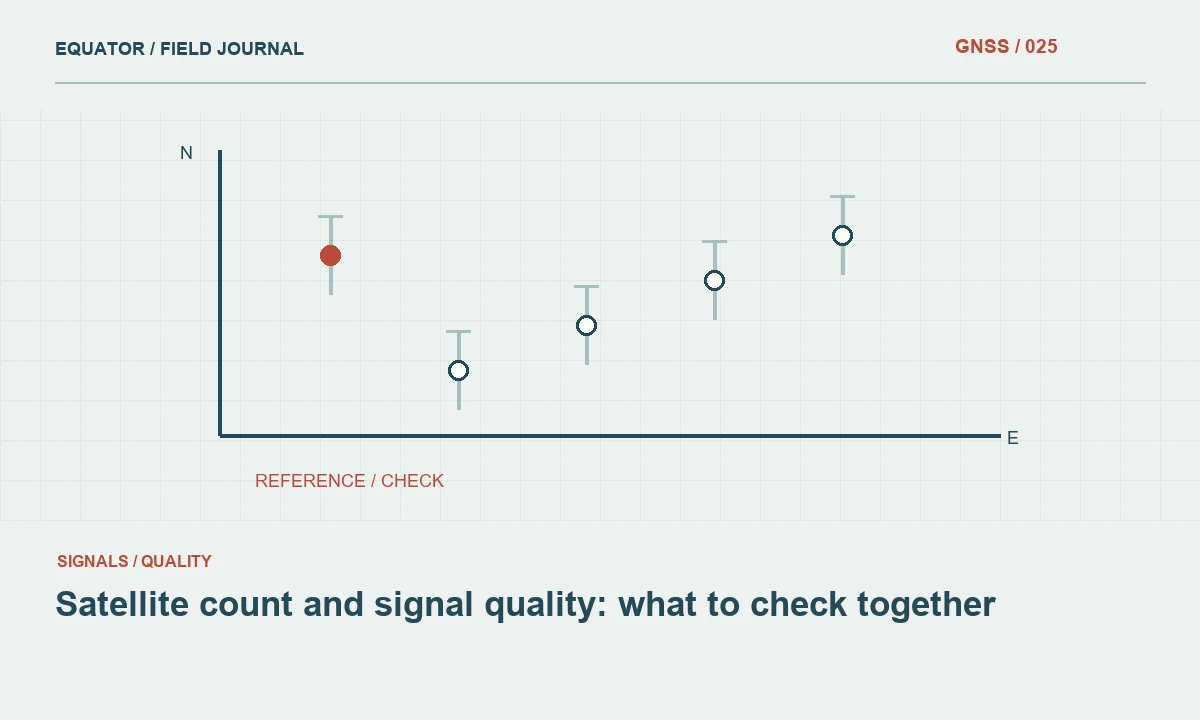
Continue learning Satellite count and signal quality: what to check together
Monitor power, recording and storage
Track receiver operation, power status where supported, local recording state and available storage. Define alerts that give operators time to respond before data is lost. A receiver can continue outputting positions while raw observations are no longer being stored, so verify the specific recording function needed by the service. Retain event logs and correlate them with file completeness.
Test backup and recovery behavior under controlled authorized conditions. Confirm what happens after a power interruption, whether recording restarts and how files are named or split. A backup power device is useful only if its actual behavior fits the installation. Document the test and its limitations, then repeat it when relevant equipment or configuration changes rather than assuming the original commissioning result remains valid indefinitely.
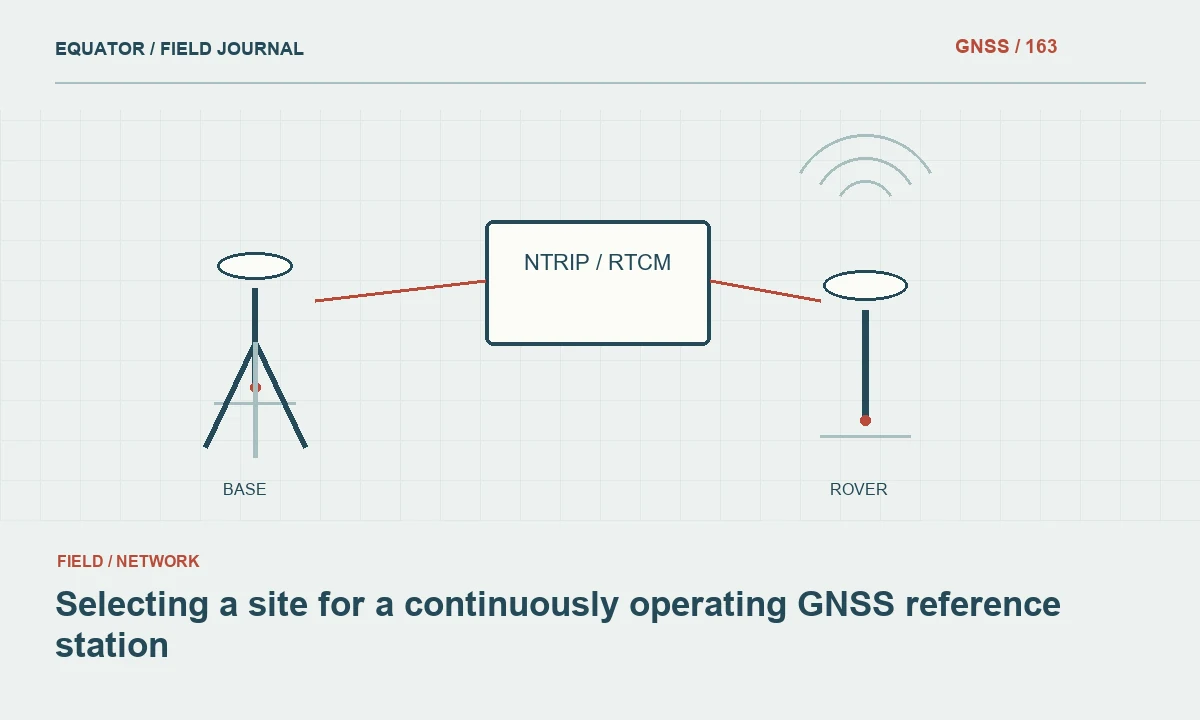
Continue learning Selecting a site for a continuously operating GNSS reference station
Check observations as well as connectivity
Inspect observation completeness, tracked signals, continuity and relevant quality diagnostics using suitable tools. A healthy network connection can deliver poor observations just as efficiently as good ones. Compare behavior over time and investigate significant changes. Keep equipment history and site events available so a quality trend can be related to maintenance, vegetation, construction or a receiver update.
Avoid treating every diagnostic change as a confirmed station fault. Satellite availability and environmental conditions also vary. Use appropriate baselines and contextual review. The monitoring system should identify periods needing attention and preserve evidence for diagnosis, while the operator determines the practical consequence for users. A clear warning with supporting data is more useful than a binary status that hides uncertainty.
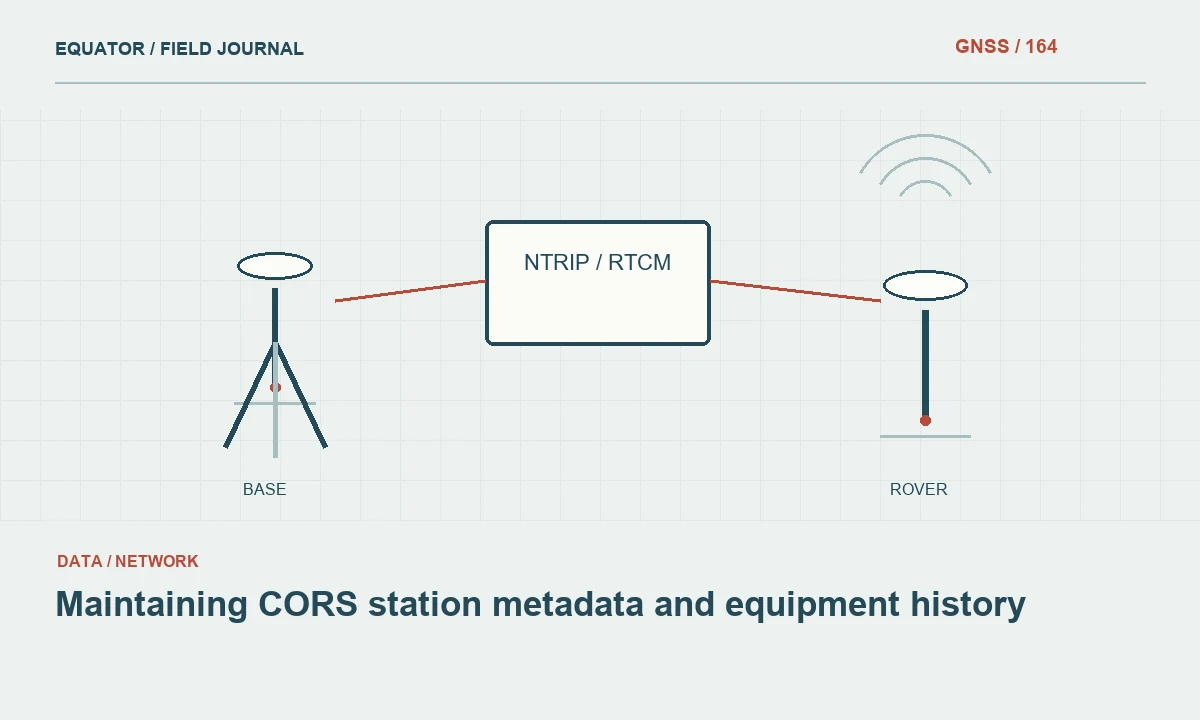
Continue learning Maintaining CORS station metadata and equipment history
Measure delivery separately for each product
For a real time stream, monitor timeliness and continuity according to the supported protocol and service requirements. For archived files, check expected arrival, time coverage, readability and metadata. File existence alone is insufficient: a file can be empty, truncated, mislabeled or contain a shorter span than expected. Use content checks that are proportionate to the service and retain their results.
Where data is sent to multiple destinations, verify each delivery path. Success at one endpoint does not establish that every user or archive received the same content. Keep retry and backlog status visible. After an outage, confirm that missing files were recovered where possible and identify irrecoverable gaps explicitly, rather than allowing a later successful transfer to erase evidence of the interruption.
Continue learning Recording drainage assets with GNSS and clear field evidence
Build an incident timeline
When an alert occurs, record the first affected time, detection time, response, recovery and remaining data gap. State the time convention. Link receiver events, communications logs, file checks and maintenance actions. A timeline helps distinguish a brief delayed delivery from permanent observation loss and allows users to identify which sessions or products may need review.
Classify the cause only as far as the evidence supports. Power failure, network outage, equipment issue and observation degradation require different corrective actions. If the cause remains uncertain, retain that status and identify the next investigation step. Closing every event with a convenient generic explanation can hide recurring problems and make the station's reliability history less useful for future planning.
Continue learning Satellite count and signal quality: what to check together
Design alerts that lead to action
Assign each important alert an owner, escalation path and expected response. Avoid overwhelming staff with repeated notifications that contain no new information. Group related symptoms where appropriate while retaining the underlying evidence. For example, a power event may explain both a missing stream and absent files, but recovery should still verify both functions separately.
Use thresholds and timing appropriate to the service objective rather than copying values from an unrelated installation. A warning should identify what failed, when it began and what action is needed. Include a route to relevant diagnostics without exposing credentials. The goal is operational clarity: staff should know whether to inspect the receiver, contact a communications provider, recover files or notify users of a quality concern.
Continue learning Selecting a site for a continuously operating GNSS reference station
Verify recovery before closing an incident
After service appears restored, check observations, recording, stream delivery, archive delivery and metadata as relevant. A connection returning does not prove that all functions resumed correctly. Confirm that the receiver uses the intended configuration and that any equipment intervention is recorded. Compare a representative recovered file with expected content and review whether a backlog remains.
If an antenna or receiver changed, update the station history with effective times. If data gaps cannot be recovered, preserve their boundaries and communicate them through the established service process. The incident should remain traceable even after dashboards return to green. Historical gaps can matter to users who later process a session that overlaps the event, long after the operational urgency has passed.
Continue learning Maintaining CORS station metadata and equipment history
Review trends and recurring weaknesses
Summarize incidents by cause, affected function and practical impact. Distinguish planned maintenance from unplanned outages and delayed delivery from lost observations. These categories support better investment decisions than a single uptime percentage whose definition is unclear. A station with excellent stream availability but repeated metadata errors may need a different improvement from one with sound observations and unreliable communications.
Use trends to prioritize maintenance, backup capacity and process changes. Repeated storage warnings may justify a better archive routine; recurring physical disturbances may require site protection or relocation. Verify improvements with evidence rather than assuming that purchasing a new component solved the problem. Keep the monitoring definitions stable enough for meaningful comparison, and document any change that affects reported performance.
Continue learning Recording drainage assets with GNSS and clear field evidence
Deliver a transparent station status history
Maintain a readable record of significant incidents, data gaps, equipment changes and recovery actions. Publish or share the information appropriate to the station's network and users. Separate public service status from private infrastructure details and secrets. Users need enough context to assess data suitability without unnecessary exposure of the operational environment.
Effective CORS monitoring protects the entire chain from antenna observations to delivered products. It recognizes that connectivity, data completeness and measurement quality are different questions, then links them through a clear incident process. This produces a station whose continuous record is not merely large, but interpretable and operationally dependable.
Continue learning Satellite count and signal quality: what to check together
Practical checklist
- Define what continuous operation means.
- Review trends and recurring weaknesses.
- Deliver a transparent station status history.
Plan your GNSS setup
Compare the EQ10 and EQ20 receiver specifications, then discuss the configuration and support your project needs.
Compare GNSS receivers