Preparing a GNSS service outage contingency plan
An outage plan should identify accepted alternatives, coordinate framework checks and a clear boundary between provisional and verified observations.
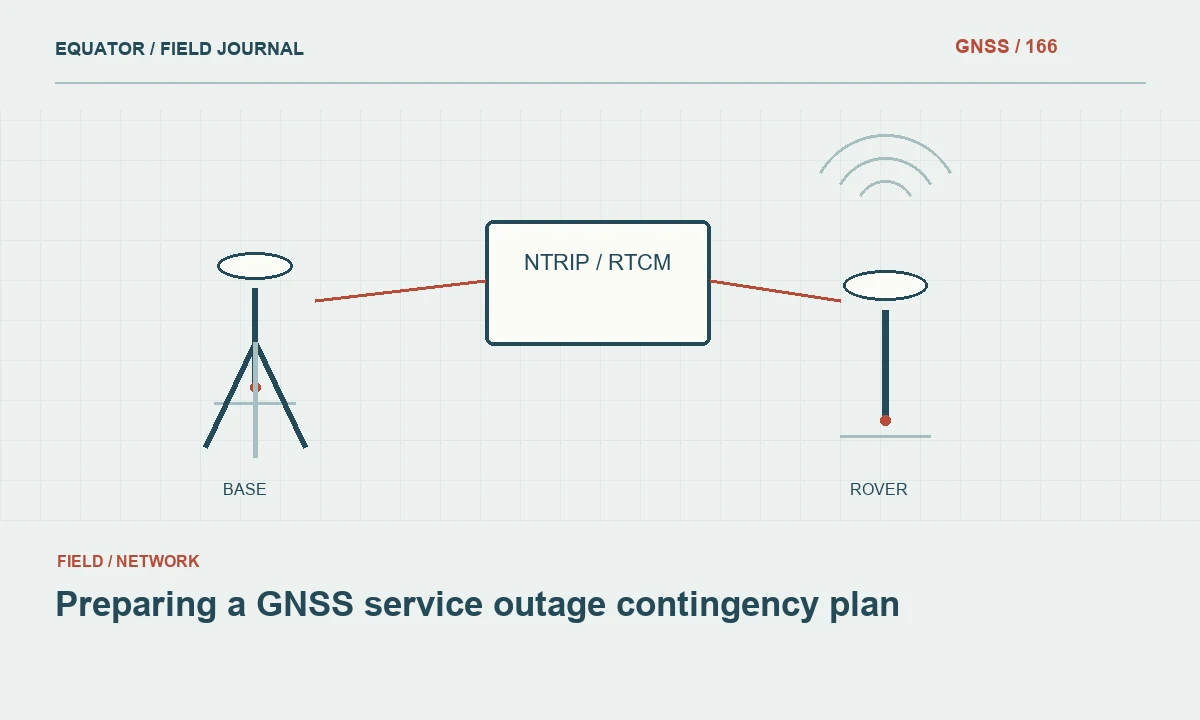
Identify the dependencies that can interrupt work
A GNSS survey can depend on satellite observations, correction services, cellular coverage, radio links, accounts, power, software and reference data. An outage in any one of these can prevent the approved method from producing suitable evidence. Begin by mapping those dependencies for the actual workflow. A generic instruction to use the backup receiver is incomplete if both receivers rely on the same failed correction service or unverified control.
Define which tasks must stop and which can continue under degraded conditions. The decision should follow the intended use and project acceptance criteria. A preliminary inventory may allow clearly labeled approximate positions, while control establishment may require a different response. Set these boundaries before an outage, so crews do not improvise a lower standard under pressure and later present provisional data as though the normal method had been followed.
Continue learning CORS and network RTK: understanding the reference service
Prepare verified alternative configurations
If an alternative correction source is part of the plan, test it in advance. Confirm message compatibility, account access, coordinate frame and any transformation needed for the project. Preserve an approved configuration rather than relying on an operator to rebuild settings during an interruption. A successful connection to a different stream is not enough if it introduces a coordinate shift that the crew cannot recognize.
If a local base is the alternative, plan its location, reference coordinates, antenna setup and communications. If postprocessing is the alternative, verify raw recording and access to suitable reference observations. If another survey technique is used, confirm its control chain. Each option needs an acceptance path; otherwise the plan merely changes the equipment while leaving the original quality question unresolved.
Continue learning Evaluating a network RTK correction service for survey work
Keep essential resources available
Store approved project definitions, control descriptions and relevant procedures in a form the crew can access without the failed service. Include suitable maps, configuration records and contact information. Protect credentials in appropriate private storage rather than public documents or shared screenshots. Test that an authorized backup operator can use the plan without depending on one person's memory or personal device.
Check practical resources such as batteries, cables, storage and communications. A backup method that requires an unavailable accessory is not operationally ready. Include these items in the preflight check and replenish them after use. The objective is a realistic ability to continue or pause safely, not a long contingency document whose assumptions have never been tested with the actual equipment and crew.
Continue learning Choosing and documenting a GNSS satellite elevation mask
Recognize the outage with specific evidence
When normal operation fails, record the time, location, symptoms and affected dependency. Check configuration and equipment before assigning the cause. A correction authentication failure, cellular interruption and satellite tracking problem can all prevent an RTK solution but require different actions. Use the supported diagnostics and preserve the event record so the office and service provider can assist effectively.
Consult official status information where relevant, but do not let a lack of a published notice override failed project checks. Likewise, a broad outage notice does not establish that every local issue has the same cause. The crew should report concrete observations and the checks already performed, allowing the project lead to distinguish a shared service problem from an equipment or site specific issue.
Continue learning Working with intermittent mobile data during RTK surveys
Switch methods through a controlled transition
Before changing the workflow, identify the last accepted point and the configuration in use. Apply the approved alternative, then verify suitable control in a compatible framework. Record the transition time and the first accepted point under the new method. This creates a clear boundary in the dataset and helps the office interpret any later discrepancy without guessing where the change occurred.
Do not silently mix coordinates from different correction frameworks or height conventions. If the alternative requires a transformation, use the documented version and check it independently as required. Keep original service coordinates and transformed values linked where the archive supports them. The transition should preserve traceability rather than produce a single coordinate table whose rows hide materially different measurement chains.
Continue learning CORS and network RTK: understanding the reference service
Handle provisional observations explicitly
If the project permits provisional collection, use a status that survives export and office processing. Record why the point is provisional and what additional evidence is required before acceptance. Avoid relying on a color or note visible only in one controller application. The office should be able to identify affected points from the delivered dataset and link them to the outage period.
Keep provisional data separate from issued accepted coordinates. A later successful connection does not retrospectively validate points collected during the interruption. Review them using raw observations, independent repeats or another approved method. Where evidence remains insufficient, recollect or restrict the use. The status change from provisional to accepted should have a recorded basis and reviewer, not occur automatically when files are merged.
Continue learning Evaluating a network RTK correction service for survey work
Test the plan before it is needed
Run an authorized exercise using representative equipment and personnel. Simulate an ordinary service unavailability through supported configuration or a controlled test environment, without disrupting shared infrastructure. Ask the crew to identify the issue, retrieve the plan, activate the alternative and verify control. Record the time, errors and missing resources. The exercise should reveal practical weaknesses before a remote project depends on the procedure.
Include office handover in the test. Confirm that configuration changes, provisional status and event boundaries survive export. A field procedure can appear successful while leaving the office unable to determine which points need review. Revise the plan based on those findings and retain an approved version. Reassess it when services, equipment, coordinate frameworks or staff responsibilities change.
Continue learning Choosing and documenting a GNSS satellite elevation mask
Return to the normal method carefully
When the primary service recovers, verify it before switching back. Check configuration, coordinate compatibility and independent control. Record the second transition with the same discipline used for the first. A normal connection indicator is not enough if the outage involved a station change, account modification or a configuration adjustment made during troubleshooting.
Review the complete affected period and reconcile accepted, provisional and rejected observations. Identify any duplicate points and retain the relationship between repeat measurements. If a replacement coordinate is issued, ensure that the earlier provisional version is clearly superseded. This prevents the outage from creating a long lived data management problem after the immediate operational issue has been resolved.
Continue learning Working with intermittent mobile data during RTK surveys
Learn from the interruption
Close the event with a summary of cause, impact, actions and remaining limitations. Distinguish confirmed findings from suspected causes. Assess whether the alternative method met its objective and whether crew communication or resources need improvement. A useful outage review changes the next response, rather than simply recording that the service eventually returned.
An effective contingency plan preserves survey quality while giving the team practical options. It recognizes shared dependencies, prepares verified alternatives and keeps coordinate frameworks and status boundaries explicit. The result is a controlled measurement process that can adapt to interruption without turning temporary operational pressure into undocumented uncertainty in the final deliverable.
Continue learning CORS and network RTK: understanding the reference service
Practical checklist
- Identify the dependencies that can interrupt work.
- Return to the normal method carefully.
- Learn from the interruption.
Plan your GNSS setup
Compare the EQ10 and EQ20 receiver specifications, then discuss the configuration and support your project needs.
Compare GNSS receivers