Reviewing residuals in a GNSS network adjustment
Adjustment residuals help reveal incompatible observations, but they must be read with the network geometry, weights and constraints.
Understand what a residual represents
A residual describes the difference between an observation and the value predicted by the adjusted model, using the software's sign convention. In a GNSS network, the observations may be processed baseline components rather than individual receiver coordinates. The adjustment distributes inconsistencies according to the geometry, constraints and assigned uncertainty. A small residual therefore indicates agreement with that particular model; it does not independently prove that the coordinate framework is correct.
Start by documenting the observation type, units and model. A residual in a baseline vector has a different interpretation from a point coordinate discrepancy against independent control. Software can also display standardized or normalized residuals, which include weighting information. Read the processing documentation before comparing their magnitudes or applying a threshold copied from a different package. Consistent terminology prevents a visually tidy report from concealing a misunderstood calculation.
Continue learning Satellite count and signal quality: what to check together
Review the network before judging individual numbers
Inspect which stations are connected, which observations overlap and which coordinates are held or constrained. A weakly connected station may have few opportunities for an inconsistency to reveal itself. A well connected network can provide more diagnostic evidence, although repeated observations with common errors are not fully independent. Draw the network and identify isolated branches, long connections and locations where control is concentrated on one side.
Next, review the coordinate reference frame, reference epoch and antenna information used in processing. An inappropriate constraint can force otherwise consistent observations into tension. A wrong antenna height can create a pattern concentrated around one station. If the adjustment includes a transformation or local coordinate fit, distinguish those residuals from the GNSS observation residuals. They diagnose different parts of the measurement chain and should be reported separately.
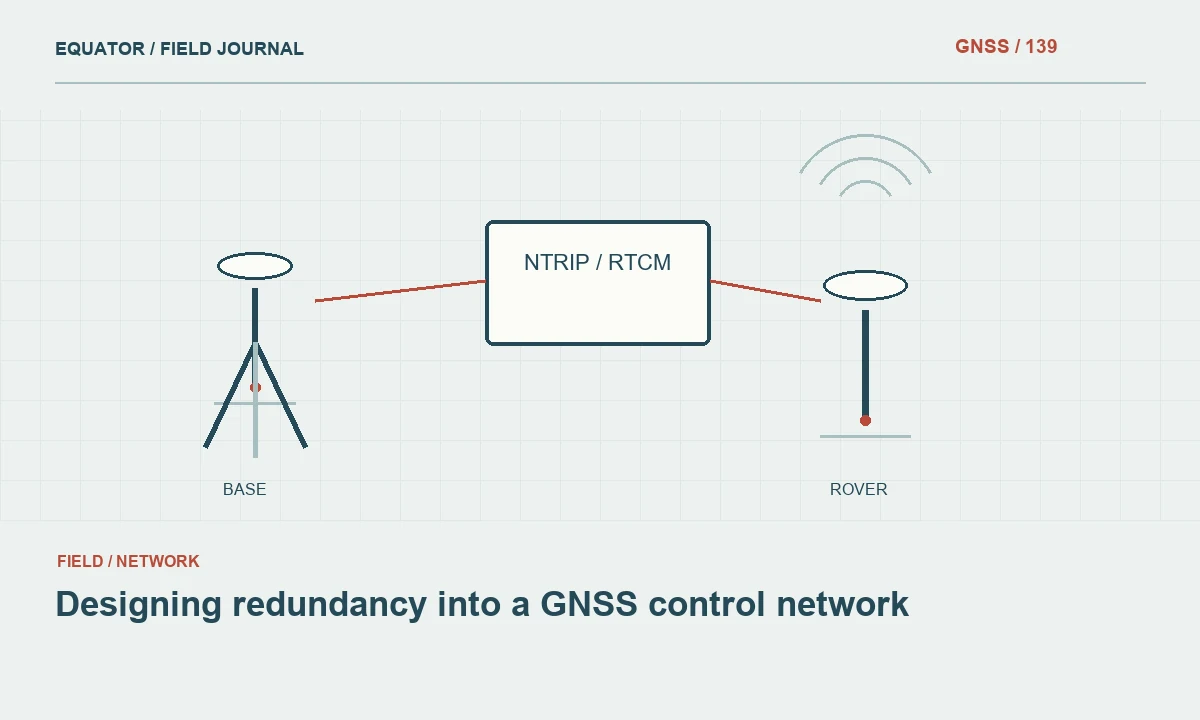
Continue learning Designing redundancy into a GNSS control network
Examine weights and uncertainty assumptions
Weights determine how strongly observations influence the solution. They should reflect a defensible uncertainty model, not a desire to make a favored observation appear correct. Processed baseline covariance information may be useful, but the reviewer should understand whether it realistically describes project conditions. A uniform uncertainty assigned to every vector may be too simplistic when observation duration, obstruction and processing quality vary substantially.
Do not respond to a large residual by automatically reducing its weight until the adjustment passes. First investigate the observation, setup and processing evidence. If reweighting is justified, record the reason and retain the original run. Compare the coordinate changes and remaining residual pattern. A statistically acceptable summary can still depend on weak assumptions, so the review should connect mathematical indicators to the physical observations that produced them.
Continue learning Using independent check points to verify GNSS surveys
Look for patterns across connected observations
Residuals involving the same station deserve a joint review. If several vectors show similar vertical tension near one setup, inspect its antenna type, reference point and height record. If discrepancies increase across the network, review scale, coordinate frame and processing choices. If only one session is unusual, inspect time coverage, tracking interruptions, atmosphere and raw data completeness for that period.
Patterns are hypotheses, not automatic diagnoses. An apparent station problem can arise from a shared reference or a common processing input. Use field notes and independent evidence to test the explanation. Preserve signed components and observation identifiers in the review table rather than reducing every result to a single magnitude. The direction and distribution of discrepancies often carry more information than a ranked list of largest values.
Continue learning Investigating vertical bias in GNSS-controlled photogrammetry
Test constraints with controlled alternative runs
Where the project method permits it, compare an appropriately minimally constrained solution with the final constrained solution. This can help separate internal observation consistency from compatibility with the adopted control. Document exactly which coordinates or parameters change between runs. A comparison is meaningful only when the differences in the adjustment setup are understood and the resulting coordinates remain associated with their respective reference definitions.
Alternative runs should answer a specific question. For example, temporarily releasing a questionable control constraint may reveal whether it is responsible for widespread tension. It does not establish that the released coordinate should be abandoned. Check its provenance, stability and uncertainty independently. Likewise, removing an observation for diagnostic purposes is different from approving its exclusion in the final network. Keep that distinction visible in the processing record.
Continue learning Satellite count and signal quality: what to check together
Use field evidence to resolve exceptions
When a residual suggests a possible blunder, trace it back to the original observation and setup. Check station naming, antenna height, antenna model, start and end times, raw data conversion and reference files. A mistaken station identifier can connect a valid observation to the wrong physical mark. Correcting such an error requires a documented link to field evidence, not an office guess about which result looks most plausible.
If the cause remains unresolved and the point is important, additional observations may be more defensible than increasingly elaborate adjustment changes. Plan the repeat to introduce useful independence, including a remade setup and appropriate network connections. Preserve the original vector with a review status. A future auditor should be able to see why it was retained, corrected, downweighted or excluded and how that decision affected the final coordinates.
Continue learning Designing redundancy into a GNSS control network
Keep a short review ledger beside the residual table
For each significant residual pattern, record the hypothesis, evidence examined, alternative run and conclusion. For example, a group of vertical residuals around one station might lead to an antenna height review. The ledger should identify the original field measurement and whether it confirms or contradicts the suspected cause. If the height was correct, retain that finding and continue investigating rather than changing it simply because the residual pattern seemed persuasive.
The ledger also helps distinguish a mathematical improvement from a stronger measurement explanation. Removing a constraint may reduce residuals while leaving the project's reference relationship unresolved. Downweighting an observation may improve a statistical test without establishing why the observation differs. Record these consequences explicitly. When the final solution is approved, the reviewer can then see which issues were physically explained, which were handled under an accepted statistical method and which remain limitations. This prevents a sequence of office experiments from becoming an undocumented search for the most attractive final adjustment summary.
Continue learning Using independent check points to verify GNSS surveys
Present residuals as part of a complete assessment
The final adjustment report should include the network definition, constraints, weighting method, statistical tests used, significant residuals and decisions on exceptions. Add independent check results where available. Residuals assess agreement within the model, while independent checks test compatibility with information outside that adjustment. Together they provide a stronger assessment than either an isolated residual table or a coordinate list with no processing context.
Summarize the practical implications for downstream users. Identify weakly determined stations, unusual uncertainty or limitations in the control framework. Retain machine readable observations and the software configuration alongside the report so the solution can be reproduced. A good residual review does not merely remove red flags from a screen; it explains why the adopted network is a reasonable representation of the observed evidence.
Continue learning Investigating vertical bias in GNSS-controlled photogrammetry
Practical checklist
- Understand what a residual represents.
- Keep a short review ledger beside the residual table.
- Present residuals as part of a complete assessment.
Plan your GNSS setup
Compare the EQ10 and EQ20 receiver specifications, then discuss the configuration and support your project needs.
Compare GNSS receivers